
How Wide Should a Chandelier Be Over a Dining Table?
The best chandelier width usually starts at about one-half to two-thirds of the dining table width. Another practical check is to leave roughly 6 inches of visible tabletop at each end of the fixture. These are design starting points, not fixed rules. Before ordering, compare the fixture's actual body dimensions with the table, room circulation, ceiling height, and nearby furniture. A paper or cardboard mock-up is the safest way to judge scale.
Quick chandelier width guide
| Dining table width | Useful starting range | What to check |
|---|---|---|
| 36 inches | 18 to 24 inches | Avoid a fixture that feels too small above a long table |
| 40 inches | 20 to 27 inches | Check chair clearance and sightlines |
| 42 inches | 21 to 28 inches | A wider airy fixture may still feel visually light |
| 48 inches | 24 to 32 inches | Confirm the chandelier body does not crowd the table edges |
For a linear chandelier, table length matters too. A common visual target is a fixture that occupies about one-half to two-thirds of the table length while remaining clearly inside both ends.
Measure the table before the room
When a chandelier hangs over a dining table, the table becomes its visual anchor. Start with three measurements:
- Table width.
- Table length.
- Distance from the tabletop to the ceiling.
Use the table width to set the chandelier's crosswise limit. Then use table length to choose between a round, branching, or linear form. Finally, confirm that the fixture body and suspension can fit vertically without blocking seated views.
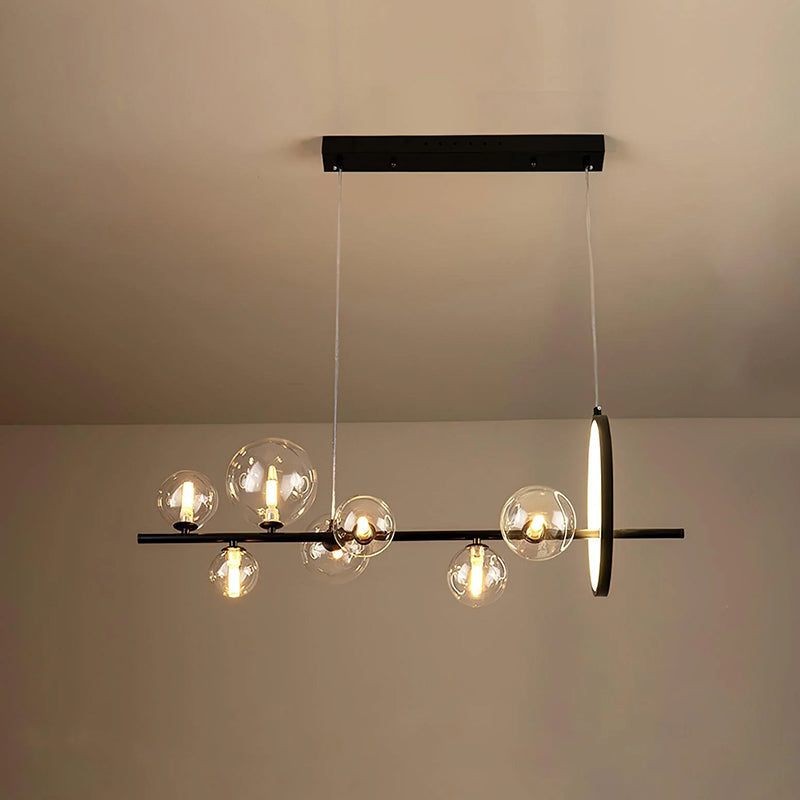
For example, the Modern Linear Glass Globe Chandelier is offered in 35.4-inch and 47.2-inch body sizes. Those dimensions make it easier to compare the fixture directly with a medium or long rectangular table instead of relying on a product photo alone.
Width and visual weight are not the same
Two chandeliers can share the same width but feel very different. A dense metal shade, a cluster of opaque stone, and an open arrangement of clear glass globes each carry a different visual weight.
An open chandelier can often occupy more horizontal space without making the room feel crowded. A solid or dark fixture may look larger than its measured dimensions. Evaluate:
- The amount of open space inside the design.
- Whether shades are transparent, translucent, or opaque.
- The thickness and color of the frame.
- The number and size of light sources.
- How low the fixture hangs in the main sightline.
The 51.2-inch Orb Chandelier, for example, has a broad span but uses glass globes and an open structure. Its measured width is still important, but the transparent material can make it appear lighter than a solid fixture of the same diameter.
Rectangular and oval tables
Long tables usually pair naturally with linear chandeliers, elongated branch forms, or two smaller fixtures placed along the centerline. Keep the chandelier centered on the table rather than automatically centering it in the room, especially when the table is not positioned under the room's geometric center.
Use painter's tape to mark the proposed fixture length on the tabletop. Sit in every chair and check whether the ends feel crowded. If the table extends with leaves, decide whether you are sizing for its everyday length or its fully extended length.
Round and square tables
A round chandelier above a round table creates an easy visual relationship. For a square table, either a round fixture or a square composition can work. The choice depends on whether you want contrast or repetition.
Do not make the fixture almost as wide as the table. A clear border of tabletop helps the arrangement feel intentional and gives diners visual breathing room. For geometric options, browse the Loonglight chandelier collection and compare listed dimensions before choosing a shape.
Do not size from room dimensions alone
Some room-sizing formulas add the room's length and width in feet and convert the total to inches. That method can help when a chandelier hangs in an open foyer, but it can oversize a fixture placed directly above a dining table. In a dining room, the table should usually be the first reference point.
Room size still matters as a secondary check. A very small chandelier can disappear in a large open-plan room, while an oversized fixture can dominate a compact dining nook. Balance both conditions, with the table setting the immediate scale.
A simple mock-up method
Cut a strip of paper or cardboard to the chandelier's published width. Suspend it at the planned height with removable tape or string. View it:
- From the dining room entrance.
- From every seated position.
- From the kitchen or living area in an open plan.
- With chairs pulled out.
- In daylight and after dark.
This five-minute test reveals more than a width formula alone.
When the usual width range may not work
The one-half to two-thirds guideline may need adjustment when:
- The fixture has a very dense or dark body.
- The table is unusually narrow.
- A large centerpiece regularly occupies the table.
- The chandelier has wide arms beyond the main shade area.
- The ceiling is sloped or the electrical box is off-center.
- The table frequently changes length.
Also check the complete product drawing. A product name may say "diameter" even when the visible form reads as linear, so use the actual length, width, and height measurements.
Final recommendation
Start with a chandelier width near one-half to two-thirds of the table width, then confirm the length, visual weight, and hanging height with a full-size mock-up. Select by actual measurements, not by room photos alone. If you are comparing styles for a specific dining layout, the dining room lighting collection provides product dimensions for a more accurate shortlist.
Frequently asked questions
Can a dining room chandelier be wider than the table?
It is usually better for the fixture body to remain visibly inside the table edges. A wider fixture can feel crowded and may be easier to bump when people stand or move chairs.
Is a 30-inch chandelier too small for a 60-inch table?
No. Thirty inches is one-half of a 60-inch table and can be an appropriate starting point. Its visual weight and shape will determine whether it looks substantial enough.
Should I measure the chandelier shades or only the frame?
Use the widest visible point of the complete fixture, including shades or globes. The published overall dimensions should be your main reference.
What if my table has extension leaves?
Choose whether everyday use or extended use matters more. For frequent extensions, a slightly longer linear fixture or a balanced pair may serve both configurations better.
Should the chandelier be centered on the table or the room?
Center it on the dining table. The relationship between the fixture and table is more visually important than the room center in most dining layouts.