
How to Choose Pendant Light Size for a Kitchen Island
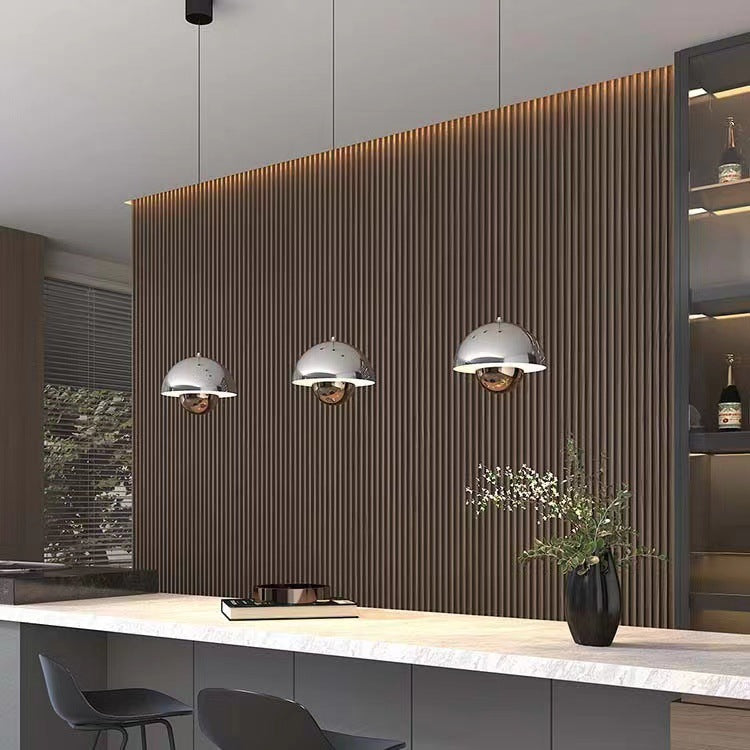
Short answer: Choose pendant diameter from the island’s width and the number of fixtures, then test the complete composition at full scale. For many islands, small pendants under about 12 inches work well in repeated groups, 12–16-inch shades are flexible for pairs or trios, and larger shades usually need fewer fixtures. These are visual-planning categories—not universal performance rules.
Size categories at a glance
| Pendant diameter | Typical planning role | Main risk |
|---|---|---|
| Under 10 in | Three or more small accents | May look underscaled or provide narrow pools of light |
| 10–12 in | Compact pairs or trios | Can become busy if spacing is tight |
| 12–16 in | Flexible pair or trio range | Must check shade gaps and sightlines |
| 17–24 in | One or two statement pendants | Can crowd narrow islands |
| Linear body | One horizontal composition | Body length may not match usable island length |
Fixture shape, opacity, and light distribution can make two products of the same diameter feel very different.
Begin with island width
Pendant diameter should relate to the island’s front-to-back depth, not only its length. A broad shade over a narrow island can feel top-heavy and may extend too close to seated users. A very small pendant over a deep island may look detached from the work surface.
A frequently used visual starting point is a shade around one-third of the island width. Treat that as a mock-up cue, not a requirement. For a 36-inch-wide island, a 12-inch shade is an easy first test. Then compare larger and smaller templates in the actual room.
Then choose the number of fixtures
The same island can support different combinations:
- two larger pendants for a calm, bold look;
- three medium pendants for balanced repetition;
- three or four small pendants for a finer rhythm;
- one linear fixture for a continuous horizontal statement.
Loonglight’s Flowerpot Pendant Light shows how one design changes with scale: it is available in 9.1-inch and 14.9-inch diameters. The smaller size is easier to repeat; the larger size has more visual presence and may suit a pair.
The Modern Minimalist Disc Pendant Light is available in 7.9-inch and 11.8-inch diameters, both only 3.9 inches high. Its shallow silhouette may feel less bulky than a deeper shade of the same diameter.
Account for shade shape and material
Diameter is only one dimension. Compare:
- Height: Deep shades occupy more of the sightline.
- Opacity: Solid metal reads heavier than clear glass.
- Profile: Wide, shallow discs emphasize horizontal width.
- Opening: A narrow opening may create a more focused pool.
- Bulb visibility: Clear glass or open shades can expose glare.
- Finish contrast: A dark fixture against a light kitchen may look larger.
The Modern Metal Cone Pendant Light measures 13.7 inches in diameter and 8.3 inches high. Its solid metal cone has more vertical presence than the shallow disc, so a pair can feel substantial even when the diameters are similar.
Calculate the complete group
For equal round pendants:
group width = outside center span + one shade diameter
If three 14.9-inch pendants have 30-inch center spacing, the group is approximately 74.9 inches wide:
30 + 30 + 14.9 = 74.9 inches
Compare that total with the usable island length. If the group leaves too little negative space at the ends, reduce the shade size, reduce the count, or consider a linear fixture.
Size a linear fixture separately
Do not apply round-shade diameter rules to a linear body. Compare the product’s actual length with the usable island length and check its depth and height.
The Faretto Linear Pendant Light is offered in 40-inch and 53.5-inch lengths. The Modern Linear Glass Globe Chandelier is offered in 35.4-inch and 47.2-inch versions. A glass-globe design may feel more voluminous than a slim bar at a similar length.
Make a full-size mock-up
Screens make fixtures look smaller than they are. Before purchase or rough-in:
- Cut cardboard to the listed shade diameter and body height.
- Hang it at the planned 30–36-inch counter clearance.
- Repeat it for the intended number of pendants.
- View the group from every entrance and seat.
- Confirm that the light source, mounting, suspension, and electrical plan also fit.
This test is especially useful in open-plan rooms, where the island lighting is visible from far away.
What is not suitable
- Do not select diameter from island length alone.
- Do not assume a transparent shade has the same visual weight as solid metal.
- Do not confuse visual scale with verified light output.
- Do not choose a large pendant without checking stool and sightline clearance.
- Do not use indoor IP20 fixtures where a damp or wet rating is required.
Frequently asked questions
What size pendant is best for a kitchen island?
There is no single best diameter. Start with island width, fixture count, and shade profile, then test full-size templates in the room.
Are 12-inch pendants too small?
Not necessarily. Twelve-inch pendants can work well as a pair or trio, especially on a narrow or medium island. Their light distribution still needs separate review.
Can I use two 18-inch pendants over an island?
Yes, if the island is wide and long enough to leave comfortable gaps and clear ends. Mock up both shades before choosing ceiling points.
Should the pendant be one-third of the island width?
One-third is a useful visual starting point, not a rule. Shape, opacity, count, and sightlines can justify a different size.
Does a larger pendant give more light?
Not automatically. Output depends on the bulb or integrated LED, diffuser, shade, optics, and mounting height—not diameter alone.
Compare real sizes
Browse Loonglight pendant lights, kitchen lighting, and linear lighting. Open each product page and record the exact dimensions before comparing.