
How to Layer Ceiling, Wall and Floor Lighting in a Living Room

A useful living room lighting plan gives each layer one clear job. Use ceiling lighting for orientation and the room's main visual anchor, wall lighting for depth or vertical surfaces, and floor lighting for reading and flexible pools of light. Start with activities, not fixture count. Then place each source on a separate control where practical so the room can shift from cleaning and entertaining to a quieter evening mode.
Quick Layer Plan
| Layer | Main Job | Best Placement | Common Mistake |
|---|---|---|---|
| Ceiling | General light and visual anchor | Over the room or seating zone | Expecting it to support every task |
| Wall | Depth, art, or architectural emphasis | At selected walls or beside seating | Installing too many bright points |
| Floor | Reading and movable ambient light | Beside the active seat or dark corner | Blocking paths with base or cord |

Step 1: List the Living Room Activities

Write down what actually happens in the room: conversation, television, reading, homework, music, display, entertaining, or circulation to another space. Mark the seat or surface associated with each activity.
This exercise prevents a common mistake: evenly filling the ceiling with light while leaving the reading chair, art wall, or sofa corner poorly served. A layered plan follows people and surfaces.
Step 2: Choose the Ceiling Layer
The ceiling layer can be a chandelier, pendant, flush mount, semi-flush fixture, or another suitable format. It should provide comfortable orientation and establish hierarchy without creating glare in seated sightlines.
In a tall room, a decorative chandelier may become the primary visual anchor. In a low or small room, a shallow fixture may preserve calm and clearance. Confirm the fixture's dimensions, total drop, structural support, voltage, control compatibility, and service access before committing.
Compare ceiling formats within Loonglight's living room lighting collection.
Step 3: Add Wall Light for Depth

Wall lighting makes vertical surfaces visible, which can help a living room feel more spacious after dark. Use it selectively for artwork, shelving, texture, or a reading position. Avoid creating a dotted line of equally bright sconces unless the architecture calls for a formal rhythm.
Keep bright sources away from television reflections and direct seated views. Electrical placement and mounting height should be reviewed for the specific fixture and room.
Step 4: Place Floor Light at the Activity
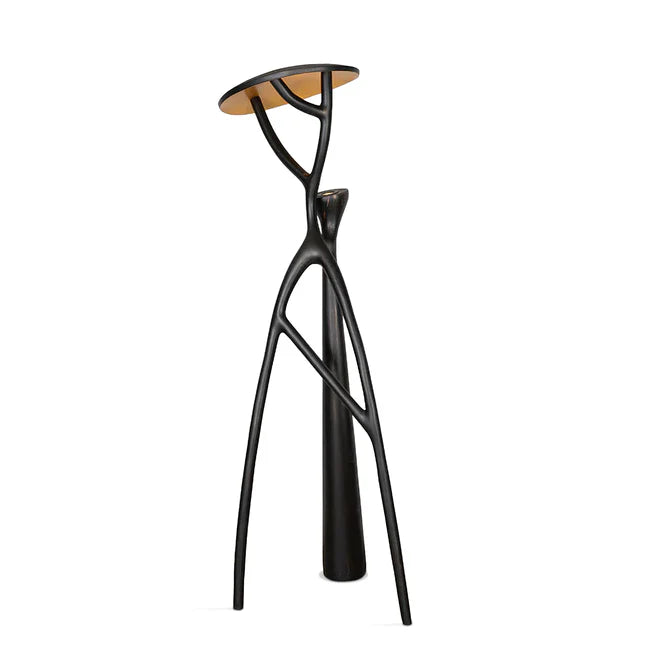
A floor lamp is valuable because it can put light close to a seat without changing the ceiling plan. Place it beside or slightly behind the reading shoulder, then check that the light reaches the page without reflecting in a screen.
The Human Standing Floor Lamp is a sculptural example rather than a discreet reading lamp. Its product page lists three sizes: 19.7 inches diameter by 63 inches high, 25.6 inches by 70.9 inches high, and 27.6 inches by 78.7 inches high. It is listed as black resin and fiberglass with integrated LED lighting, a freestanding installation, 110-240V, IP20 indoor use, and plug options for several regions.
Its large footprint and figure-like form can create a dramatic accent, but it is not suitable for a narrow walkway or a room that already has several focal pieces. Confirm actual task-light performance before treating it as the room's primary reading source.
Step 5: Design the Evening Scene

Test three scenes:
- Full room for cleaning or arrivals.
- Conversation mode with softened ceiling and wall light.
- Reading or television mode with localized floor light and minimal reflection.
Separate controls make these changes easier. Do not assume every integrated LED fixture is dimmable. Verify the driver, dimmer type, minimum load, and local electrical compatibility.
Balance Brightness and Visual Weight
Layering is not the same as making every source equally bright. Choose one visual leader, one or two supporting sources, and areas of intentional shadow. Coordinate visible color temperature and glare control so the room feels composed.
For a bold floor lamp, keep the ceiling fixture quieter. For a statement chandelier, use simpler floor and wall lights.
FAQ
Does a living room need all three layers?
Not always. Use only the layers required by the room's activities and architecture.
Where should a floor lamp go beside a sofa?
Place it close enough to light the active seat but outside the circulation path. Check the base, cord, shade, and screen reflections.
Can wall lights replace floor lamps?
They can support reading or accent functions when properly positioned, but they are less flexible once installed.
Should all living room lights be dimmable?
Dimming can improve flexibility, but compatibility must be verified for each fixture, driver, control, and circuit.