
Linear Chandelier vs Multiple Pendants Over a Kitchen Island
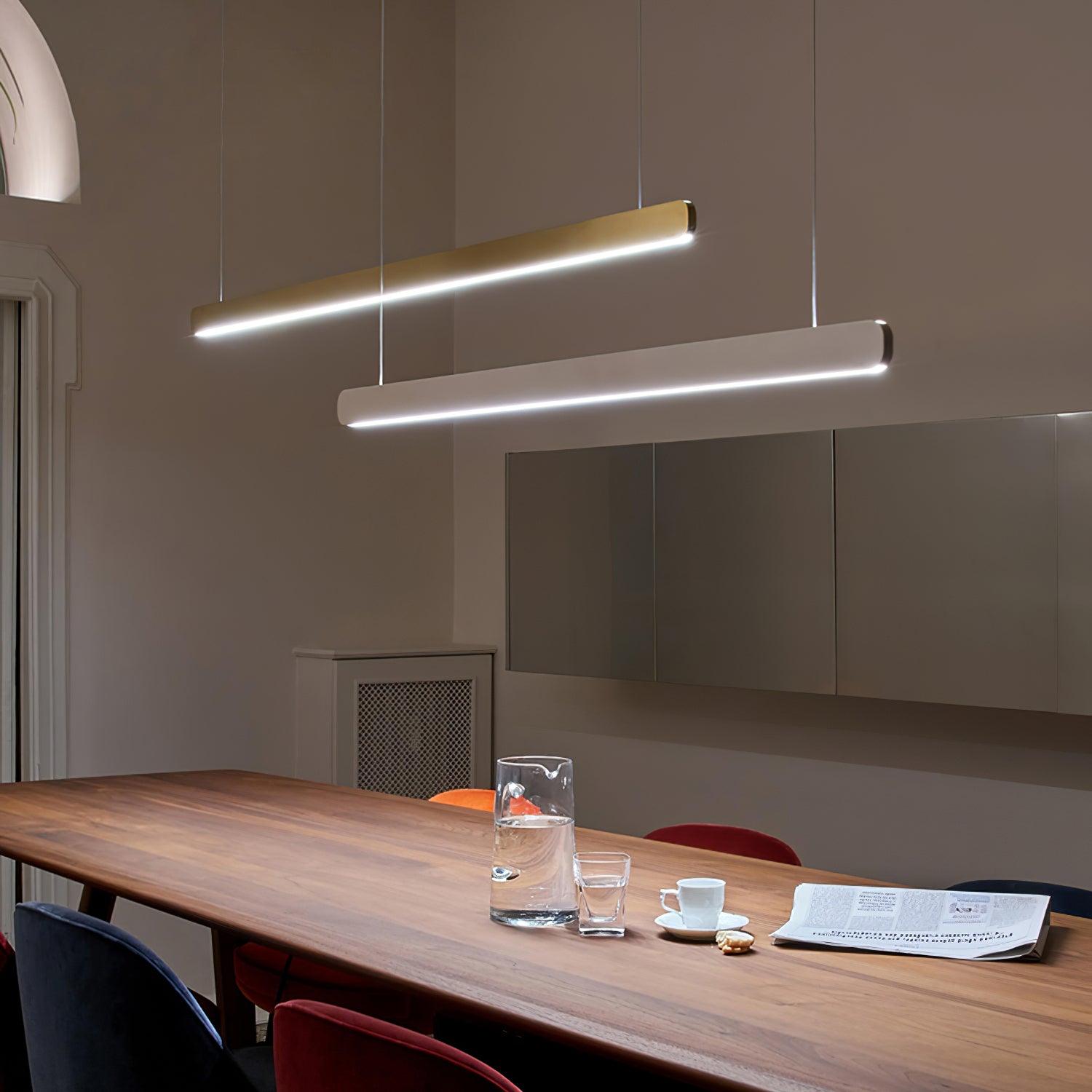
Short answer: Choose a linear chandelier when you want one continuous composition, fewer ceiling canopies, and strong horizontal coverage. Choose multiple pendants when you want adjustable rhythm, more style flexibility, or separate points of light across work zones. Neither is automatically brighter or better: compare the actual fixture length, light source, beam spread, mounting system, and island layout.
Fast comparison
| Decision factor | Linear chandelier | Multiple pendants |
|---|---|---|
| Visual effect | One architectural statement | Repeated rhythm |
| Ceiling layout | Usually one coordinated canopy/system | Multiple ceiling points |
| Long islands | Often visually efficient | Works when spacing is generous |
| Asymmetric work zones | Less flexible once centered | Individual positions can follow zones |
| Installation alignment | One fixture must align accurately | Every pendant must align accurately |
| Future styling changes | Replace one large fixture | Replace or regroup individual pendants |
| Sightline | Depends on frame and body depth | Depends on shade size and count |
When a linear chandelier is the stronger choice
A linear fixture follows the island’s long axis, so it can visually connect a wide work surface without creating several separate objects overhead. This format often suits:
- long rectangular islands;
- minimalist or architectural kitchens;
- rooms where repeated canopies would look busy;
- islands that need one strong focal point;
- layouts where equal pendant spacing is difficult.
Loonglight’s Faretto Linear Pendant Light has integrated LED lighting and comes in 40-inch and 53.5-inch lengths. Its product page lists a metal construction, multiple finish choices, and 3000K, 4500K, or 6000K color-temperature options. The fixture is IP20 and intended for indoor use, so it is not suitable where a damp or wet rating is required.
The Modern Linear Glass Globe Chandelier uses metal and glass with G9 bulbs plus integrated LED elements. Its 7-head and 10-head versions measure 35.4 inches and 47.2 inches across. The glass globes create a different visual weight from a slim bar, even when the overall lengths are similar.
When multiple pendants are the stronger choice
Individual pendants are useful when you want the lighting rhythm to respond to specific work zones. They can also introduce color or repeated sculptural forms.
The Modern Metal Cone Pendant Light has a 13.7-inch metal shade and an E26 or E27 lamp holder. A row of identical cone shades creates focused downward emphasis while allowing the bulb choice to be reviewed separately. The Flowerpot Pendant Light, available in 9.1-inch and 14.9-inch diameters, gives you two scales for pairs or trios.
Multiple pendants are especially helpful when:
- the island contains distinct prep and seating zones;
- you want color repeated across the room;
- a single long fixture would dominate the view;
- the island is short enough that two shades feel complete;
- separate points of light better match the ceiling architecture.
Compare total width, not product category
“Linear” does not always mean “large,” and “multiple” does not always mean “busy.” Compare the complete composition:
group width = distance between outside centers + one shade diameter
For three 13.7-inch pendants spaced 28 inches center to center, the approximate group width is:
28 + 28 + 13.7 = 69.7 inches
That is wider than either Faretto size. The pendant group may therefore suit a longer island even though each fixture is smaller. Conversely, two large pendants can occupy less ceiling width while having greater visual mass.
Compare lighting performance separately
Do not infer output from the number of visible lights. Check:
- delivered lumens, if documented;
- beam direction and diffuser;
- bulb base and maximum wattage;
- integrated LED specifications;
- color temperature;
- dimmer compatibility;
- glare at the intended hanging height.
The Loonglight pages reviewed for this article list light-source types and color-temperature ranges but do not provide enough verified photometric data to declare one option brighter. Treat appearance and performance as separate decisions.
Installation and maintenance tradeoffs
A linear fixture may simplify the visual ceiling plan, but its body must be centered and leveled carefully. Long fixtures can also require two-person handling. Multiple pendants require repeated measurement so every center and drop matches.
For maintenance, individual bulb-based pendants may allow a single lamp to be changed, while an integrated LED fixture uses its own driver and light engine. Before purchase, confirm replacement parts, compatible bulbs or drivers, dimmer requirements, and service access.
Which option suits each design goal?
| Goal | Better starting format |
|---|---|
| Cleanest horizontal line | Linear chandelier |
| Repeated color or material | Multiple pendants |
| One strong focal point | Linear chandelier |
| Flexible response to work zones | Multiple pendants |
| Very long island | Compare a long linear fixture with 3–4 pendants |
| Open view across kitchen | Choose the option with the least visual blockage |
What is not suitable
- Do not assume more bulbs equal better task light.
- Do not select a linear fixture without checking its actual body length.
- Do not install several pendants before testing shade gaps and sightlines.
- Do not assume dimming compatibility from the word “LED.”
- Do not use these indoor IP20 examples where a damp or wet rating is required.
Frequently asked questions
Is a linear chandelier better than three pendants?
It is better when you want one horizontal statement and a simpler composition. Three pendants are better when repeated rhythm or separate work-zone positions matter more.
How long should a linear light be over an island?
Use a fixture noticeably shorter than the usable island length so both ends retain visual breathing room. Mock up the listed product length before purchase.
Are multiple pendants harder to install?
They require more repeated alignment and may require multiple ceiling boxes or a multi-port canopy. The exact difficulty depends on the product and existing wiring.
Can a linear chandelier light the whole kitchen?
It should be treated as one layer. Most kitchens also need ambient and under-cabinet or other task lighting.
Which looks better in an open-plan kitchen?
The option that preserves the important sightline. Slim linear bars and fewer larger pendants can both work; evaluate the view from adjacent rooms.
Compare Loonglight options
Browse linear lighting, pendant lights, and the kitchen lighting collection with your island measurements in hand.