
How to Choose a Chandelier for a Living Room with a Sectional Sofa

Choose the chandelier around the living room's visual center, not automatically around the room's four walls. With an L-shaped or U-shaped sectional, that center is usually the coffee table and conversation zone. A fixture that relates to this zone will feel intentional even when the sofa is asymmetrical. Before buying, compare fixture diameter, overall drop, ceiling height, furniture sightlines, and the light needed for reading or entertaining.
Quick Decision Guide
| What to Check | Why It Matters | Best Direction |
|---|---|---|
| Conversation-zone center | A sectional shifts the visual center | Center over the coffee table or seating composition |
| Fixture shape | Shape can reinforce or fight the furniture geometry | Round softens an angular sectional; linear follows a long layout |
| Diameter | An undersized fixture looks disconnected | Relate scale to the seating zone, not only the room |
| Overall drop | Low fixtures can block views | Keep the bottom comfortably above normal sightlines |
| Light output | Decorative glow may not support reading | Add floor, table, or wall lighting |

Start with the Seating Zone
A sectional often occupies more visual weight on one side of the room. If the chandelier is centered on the architectural room while the coffee table and seating sit off-center, the result can look accidental. Instead, map the area where people actually sit and face one another.
Use the coffee table as the first reference point when it sits near the middle of the sectional. In an open-plan room, also check the rug boundary. The chandelier should help identify the living zone without drifting into a circulation path or competing with dining lighting nearby.
This is a design-centering method, not an electrical rule. A qualified electrician still needs to confirm the ceiling junction location, support, wiring route, and local code requirements.
Match the Chandelier Shape to the Sectional
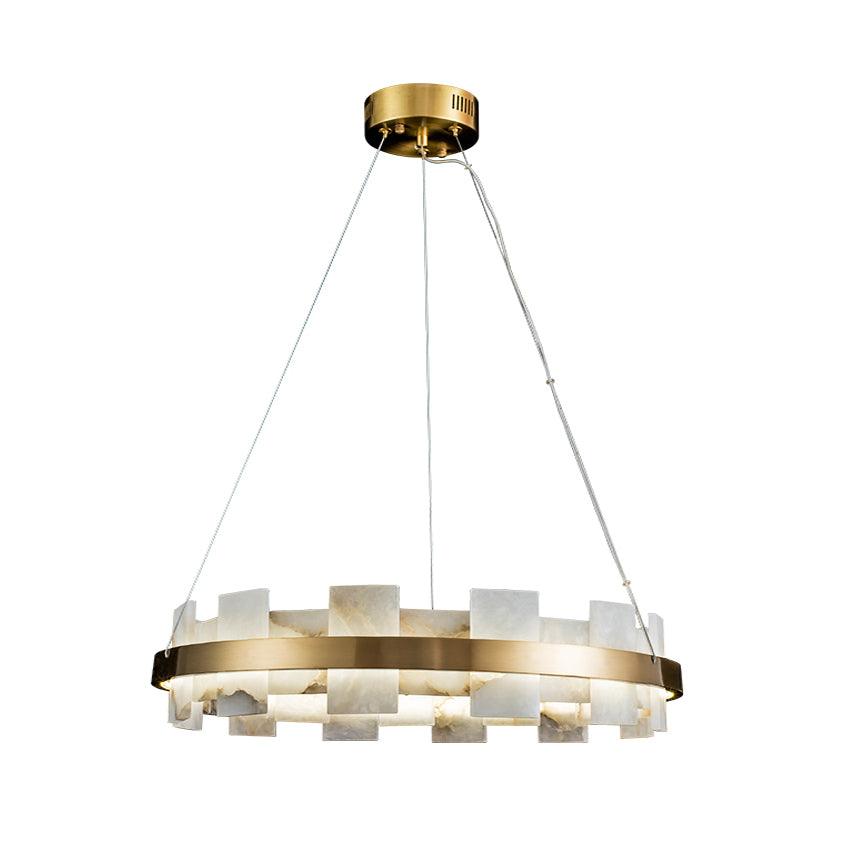
A circular chandelier can soften the hard corners of an L-shaped sofa and create a clear center. A long linear fixture can work when the sectional and coffee table both extend strongly in one direction. A cluster or sculptural form suits a taller room where the fixture can be viewed from several angles.
The Alabaster Halo Chandelier is a useful example of a round, sculptural form. It is offered in 23.6-inch and 31.5-inch diameters, with two design models. The product page lists brass, metal, and alabaster, integrated LED lighting, hardwired pendant mounting, and an IP20 indoor rating. Natural alabaster veining varies, so the delivered stone will not exactly match the photography.
Its ring form can relate naturally to a round or oval coffee table. It is less suitable when the room has a low ceiling, the furniture zone is very small, or the planned drop would interrupt views across the sectional.
Choose Scale from the Furniture Outward

Do not choose diameter from a room formula alone. Measure three nested areas:
- The coffee table.
- The rug and sectional composition.
- The full room.
The chandelier should feel larger than a small table accessory but smaller than the entire seating footprint. Tape the proposed diameter on the floor, then stand at the main entrance and at each end of the sectional. This quick mock-up reveals whether the fixture will read as a focal point or disappear.
If the chandelier has a deep body or long decorative elements, mock up its bottom edge with painter's tape on a wall. Check views toward the television, fireplace, windows, and people seated opposite one another.
Plan for Ceiling Height and Sightlines

Living room chandeliers are not positioned like dining fixtures. There may be no table directly below to keep people away from the drop. The bottom of the fixture needs to stay clear of walking routes and comfortable seated views.
For standard ceilings, a shallow chandelier or pendant-style ceiling fixture is often easier to place. Tall foyers and double-height living rooms can accept a deeper statement piece, but scale and service access become more important. Confirm canopy dimensions, overall fixture height, suspension adjustability, ceiling support, and how the fixture will be cleaned.
Add Task and Accent Lighting

Even an attractive chandelier should not be asked to do every job. A practical living room uses layers:
- Ceiling lighting for general orientation.
- Floor or table lamps beside the sectional for reading.
- Wall or directional lighting for art, shelves, or architectural texture.
- Lower-output evening light for relaxation.
Browse the living room lighting collection to compare ceiling, wall, table, and floor-light formats rather than selecting the chandelier in isolation.
When a Chandelier Is Not the Best Choice
A chandelier may be the wrong format when the ceiling is low, the seating zone overlaps a busy walkway, the television sightline is already crowded, or the room lacks appropriate structural support. A flush or semi-flush ceiling light with portable lamps may produce a calmer and more flexible plan.
The Alabaster Halo Chandelier is also not intended for wet locations. Its product page lists IP20 and indoor use. Confirm dimming behavior, driver access, final suspension range, installation instructions, and any certification needed for your project before ordering.
FAQ
Should a chandelier be centered over the sectional or the room?
Usually center it on the conversation zone, often defined by the coffee table, rug, and sectional. In a symmetrical closed room, that point may also be the architectural center.
Can a round chandelier work with an L-shaped sofa?
Yes. A round chandelier can soften the sectional's angles and create a visual center, especially when paired with a round or oval coffee table.
Is one chandelier enough for a living room?
Rarely. Add task lighting near reading seats and accent lighting where the room needs depth. The chandelier can anchor the scheme without carrying every lighting function.
What should I verify before installation?
Verify ceiling support, junction-box location, overall drop, walking clearance, dimming compatibility, voltage, service access, and local electrical requirements with a qualified professional.