
One Large Chandelier vs Two Smaller Chandeliers Over a Long Table
Choose one large or linear chandelier when you want a single focal point and simpler alignment. Choose two smaller chandeliers when the table is very long, the room needs repeated rhythm, or one fixture cannot spread light evenly to both ends. The better option depends on table length, ceiling junction boxes, fixture width, and the visual space between the lights. Mock up both arrangements before changing electrical positions.
Quick comparison
| Decision factor | One large chandelier | Two smaller chandeliers |
|---|---|---|
| Visual effect | Strong single centerpiece | Repetition and rhythm |
| Alignment | One center point | Two evenly spaced centers |
| Electrical work | Often simpler | May require a second junction box |
| Long-table coverage | Best with a linear form | Naturally extends coverage |
| Flexibility | Easy to coordinate | More spacing decisions |
| Main risk | Looking too short or bulky | Looking crowded or disconnected |
When one chandelier works best
One chandelier is usually the cleanest choice for a six- to eight-seat table when a suitable fixture length is available. A linear or branching form can spread light along the table while maintaining one visual center.
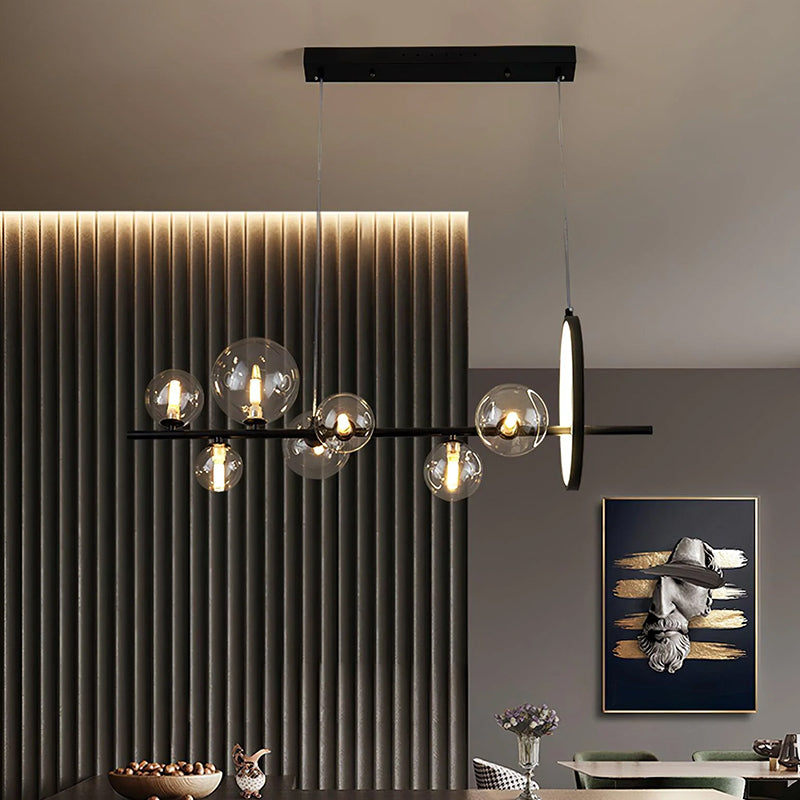
The Modern Linear Glass Globe Chandelier is available in 35.4-inch and 47.2-inch sizes. The 47.2-inch option can relate to a longer rectangular table without introducing a second canopy. Use the fixture's actual body length, not the width of the styled photo, when judging coverage.
One fixture may also be better when:
- The ceiling has one centered electrical box.
- The room already contains several strong focal points.
- The table changes position.
- You prefer a calm, continuous silhouette.
- The chandelier itself has multiple distributed light sources.
When two chandeliers work best
Two smaller chandeliers can make a long table feel more evenly organized. They work particularly well when the table seats eight or more people, the room is long and narrow, or the architecture already uses repeated bays.
The pair should read as one composition. Match their height, distance from the table centerline, and spacing from the ends. Small differences become obvious when the fixtures repeat.
Two fixtures may be better when:
- A single chandelier looks undersized at the table ends.
- A very large fixture would feel too heavy.
- The room benefits from symmetry.
- The table is exceptionally long.
- You want separate pools of light for two seating zones.
How to space a pair
Start by dividing the table length into two equal zones. Place each chandelier near the center of its zone, then check the space between them and the distance to the table ends.
A practical visual check is to keep the outside edges of both fixtures clearly inside the table ends. The center gap should feel deliberate rather than accidental. If the fixtures nearly touch, one larger or linear chandelier may be cleaner. If the gap is very wide, the middle of the table may feel visually empty.
Use paper circles or cardboard silhouettes at the planned diameter and hang them at the intended height. View the pair from the table ends as well as from the side.
Compare total visual width
Do not compare only the diameter of one small fixture with the length of one large fixture. For a pair, calculate:
fixture width + center gap + fixture width
That total composition must fit comfortably within the table length. Also account for shades, arms, or globes that extend beyond the canopy.
The 51.2-inch Orb Chandelier demonstrates why visual weight matters. Its open glass structure spans a broad area. Two fixtures with similar diameter would require a very long table and room, even if each appeared airy.
Light output and layering
More fixtures do not automatically mean better lighting. Check the number of light sources, shade diffusion, bulb output, and other room lighting.
A large chandelier can provide broad ambient light when its sources are distributed. Two smaller fixtures may create more even pools along the table, but can also produce glare if exposed bulbs sit directly in diners' sightlines.
Plan the chandelier as one layer. Wall lights, recessed lighting, or lamps can support the room without forcing the chandelier to provide every lumen.
Electrical and ceiling constraints
One chandelier usually needs one correctly located junction box. Two chandeliers normally need two secure mounting points and coordinated wiring. Do not assume a decorative ceiling plate can support a second fixture.
Before selecting a pair, have a qualified installer confirm:
- Junction-box locations.
- Ceiling support.
- Circuit and control plan.
- Compatibility with dimmers, if desired.
- Equal suspension lengths.
If the table is not permanently positioned, one centered fixture may be more forgiving.
Common mistakes
Choosing two fixtures that are too large
The pair can overwhelm the table even when each chandelier looks modest on its own. Evaluate the total composition.
Leaving the center too dark
Widely spaced fixtures can make the middle feel empty. Check both visible rhythm and actual light distribution.
Installing before testing height
A pair hung too low creates twice the obstruction. Test seated sightlines for both fixtures.
Ignoring table extensions
If leaves are used frequently, check the arrangement at both everyday and extended lengths.
Explore measured options in the Loonglight dining room lighting collection before deciding whether one body or a pair better fits the table.
Final recommendation
Use one linear chandelier for a unified centerpiece and simpler installation. Use two smaller chandeliers when the table's length needs repeated coverage and the ceiling can support two precisely aligned mounting points. Compare the total width of the full composition, then mock up the spacing and height before electrical work begins.
Frequently asked questions
How long should one chandelier be over a long table?
One-half to two-thirds of the table length is a useful starting range for a linear fixture. Keep the body visibly inside the table ends.
How far apart should two dining chandeliers be?
There is no universal number. Center each fixture over half of the table, then adjust so the center gap and end margins look balanced.
Can I hang two chandeliers from one junction box?
Do not assume so. A qualified installer must confirm the mounting and wiring plan for the exact fixtures and ceiling.
Do two chandeliers need to match?
Matching fixtures create the clearest rhythm. Coordinated but different fixtures can work, but their scale, height, and material need a deliberate relationship.
Is one large chandelier brighter than two small ones?
Not necessarily. Brightness depends on light output, number of sources, shade material, and room lighting, not fixture count alone.