
How to Choose Warm Dining Room Lighting Without Making the Room Too Dim
Choose a warm color temperature, then evaluate brightness separately. Around 2700K to 3000K often creates a comfortable residential dining atmosphere, but Kelvin does not tell you how much light reaches the table. To avoid a dim room, combine sufficient light output with good shade diffusion, multiple light sources, reflective surfaces, and supporting wall or ceiling light. Verify the product's output and control compatibility before ordering.
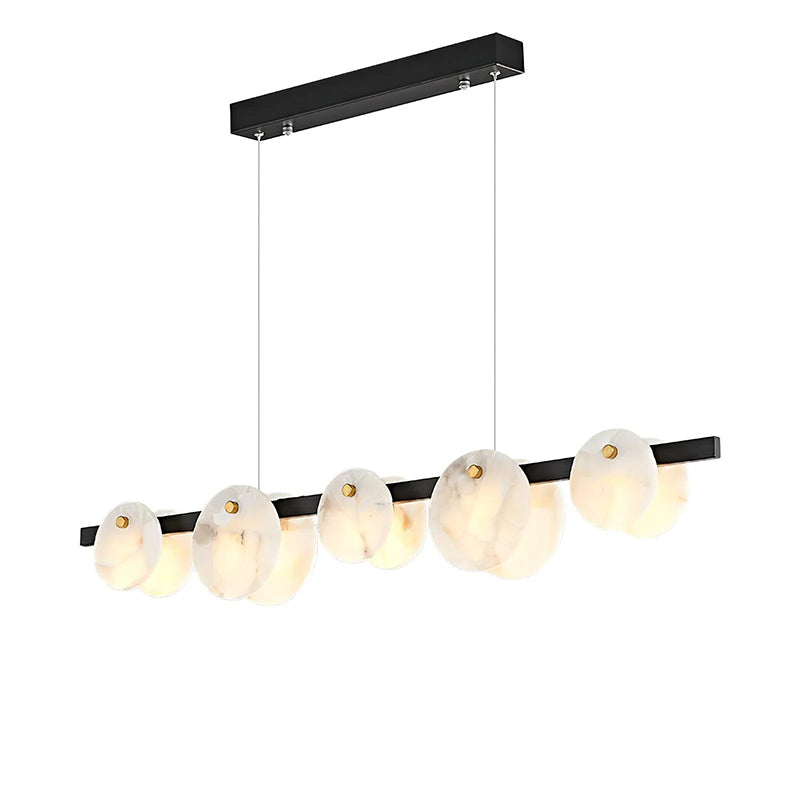
Warmth and brightness are different
| Lighting term | What it describes | What it does not tell you |
|---|---|---|
| Kelvin | Color appearance from warm to cool | Total brightness |
| Lumens | Amount of visible light | Whether glare is controlled |
| Diffusion | How a shade softens and spreads light | Total room coverage |
| CRI | How naturally colors appear | Fixture brightness by itself |
| Dimming | Ability to reduce output | Compatibility without verification |
A 3000K fixture can be bright or dim. A 6000K fixture can also be bright or dim. Color temperature changes the appearance of light, not the amount of light by itself.
Start with 2700K to 3000K for a warm mood
For many homes, 2700K feels warm and intimate, while 3000K feels warm but slightly clearer. Dark wood, brass, cream textiles, and warm wall colors often respond well to this range.
The Lunar Glow Alabaster Chandelier lists a 3000K warm-light option. Its alabaster discs diffuse the integrated LED light, producing a softer appearance than an exposed source. Because natural alabaster varies in veining, each shade can also differ visually from product photography.
Do not select color temperature in isolation. Consider wall color, daylight, and the other bulbs already used in adjacent rooms.
Estimate how much light the room needs
Dining rooms need enough light for serving, reading menus, cleaning, and seeing food clearly. The chandelier may provide much of the ambient layer, but it does not need to do every job alone.
Before choosing, record:
- Room length and width.
- Ceiling height.
- Table size and finish.
- Existing recessed or wall lighting.
- Shade transparency.
- Number and type of light sources.
Dark walls, matte finishes, and opaque shades absorb more light. Pale walls, glass, and reflective surfaces return more light to the room. The same fixture can therefore feel brighter in one dining room than another.
Use diffusion without losing all direction
Translucent stone and frosted glass can reduce glare and make warm light feel calm. However, a heavily enclosed shade may also reduce direct light on the table.
The goal is not maximum diffusion. It is balanced diffusion. Look for a fixture that softens the source while allowing useful light to reach the tabletop and surrounding room.
The Alabaster Square Box Chandelier uses alabaster shades with G9-base bulbs and lists a 3000K to 6000K color-temperature range. Its multi-light configurations distribute sources across linear or square frames. Confirm the selected bulb output and fixture configuration before purchase.
Layer the dining room
A warm chandelier works best as part of a simple lighting plan:
- Ambient light from the chandelier or ceiling.
- Accent light on art, cabinetry, or architectural surfaces.
- Optional wall light that brightens faces and room edges.
This layered approach prevents the common "bright table, dark room" effect. It also allows the dining room to feel intimate without making circulation areas hard to see.
Browse dining room lighting by fixture type and consider how each piece would contribute to the full room rather than only the table.
Control glare at seated eye level
Warm exposed bulbs can still be uncomfortable when they sit directly in the line of sight. Check product images and dimensions to see where the light sources sit relative to the shade.
When testing height:
- Sit in every chair.
- Look across the table.
- Check reflections in glossy tabletops or mirrors.
- View the fixture from adjacent rooms.
Glass globes can spread light broadly, while alabaster and other translucent materials soften it. Neither is automatically better. The room and desired effect determine the choice.
Check dimmer and bulb compatibility
Dimming can make a dining room flexible, but compatibility must be confirmed for the exact light source, driver, and control. Do not assume every LED fixture or replacement bulb works with every dimmer.
For bulb-based chandeliers, check the required base, maximum supported wattage, bulb dimensions, and whether the chosen bulb is dimmable. For integrated LED fixtures, confirm the driver and dimmer requirements with the product information or support team.
Keep color temperature consistent
Mixing 2700K chandelier light with very cool recessed light can make the room feel visually disjointed. Nearby sources do not have to match perfectly, but large differences are noticeable.
Choose a target range for the connected dining, kitchen, and living zones. If the rooms are open to each other, view all sources at night before finalizing bulbs.
When warm lighting may not be the best choice
A warmer setting may not be ideal as the only light when:
- The dining table is also a detailed workspace.
- The room has very dark surfaces and little supporting light.
- Accurate color evaluation is important.
- The fixture has strongly tinted shades.
- The space receives almost no daylight and needs an energetic daytime mode.
A multi-temperature product can add flexibility, but verify how its settings are controlled and retained.
Final recommendation
Select 2700K to 3000K for a warm dining mood, then use lumens, shade diffusion, fixture distribution, and supporting light to prevent dimness. Treat color temperature and brightness as separate decisions. Verify bulb or integrated LED specifications and any dimmer requirements before installation.
Frequently asked questions
Is 3000K warm enough for a dining room?
For many homes, yes. It usually appears warm while remaining clearer than 2700K. Room colors and neighboring light sources affect the result.
Does warm light use fewer lumens?
Not automatically. Kelvin and lumens measure different qualities. Compare the listed output of the exact bulb or integrated light source.
Are alabaster chandeliers too dim?
Not necessarily. Alabaster diffuses light, but total brightness depends on the number and output of the sources, shade thickness, room surfaces, and supporting lighting.
Should dining room lighting be dimmable?
It can be useful for changing between meals and brighter tasks. Confirm compatibility for the fixture, bulbs or driver, and wall control.
How can I brighten a dining room without using cooler light?
Add supporting wall or ceiling light, use adequate lumens, improve surface reflectance, and choose a fixture that distributes light beyond the center of the table.